> For the complete documentation index, see [llms.txt](https://testbox.ortusbooks.com/llms.txt). Markdown versions of documentation pages are available by appending `.md` to page URLs; this page is available as [Markdown](https://testbox.ortusbooks.com/browser-testing/browser-matchers.md).
# Browser Matchers
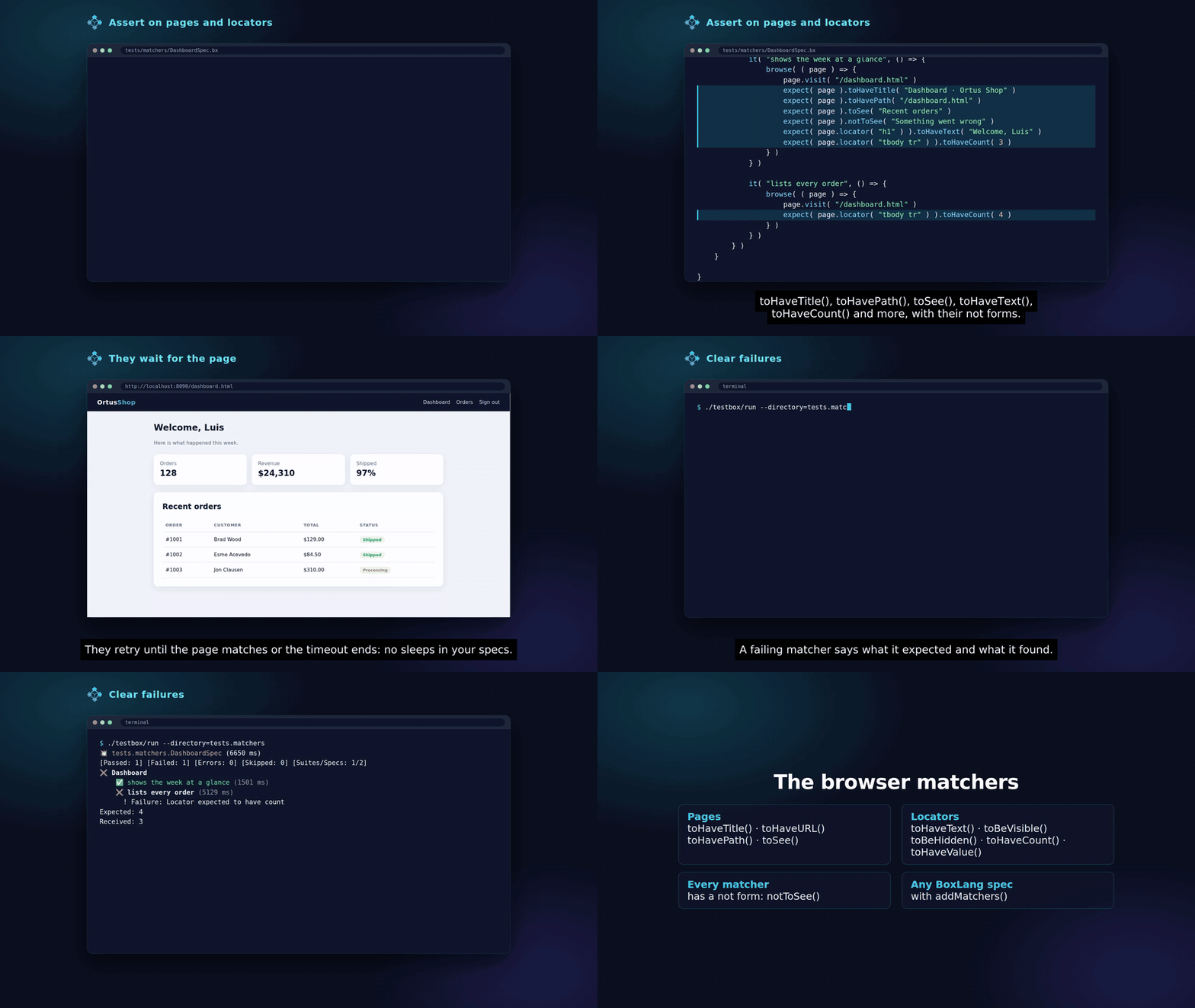
TestBox expectations for bx-playwright pages and locators that wait for the page.
The browser matchers let you assert on bx-playwright pages and locators with the TestBox `expect()` DSL you already use:
```java
expect( page ).toHaveTitle( "Dashboard" )
expect( page ).toHavePath( "/dashboard" )
expect( page ).toSee( "Welcome" )
expect( page ).notToSee( "Error" )
expect( page.locator( ".todo" ) ).toHaveCount( 3 )
expect( page.locator( "@error" ) ).notToBeVisible()
```
{% hint style="info" %}
These matchers require BoxLang: they live in `testbox.system.browser.BrowserMatchers`, a BoxLang class built on bx-playwright. On BoxLang without bx-playwright, [browser](/browser-testing/browser-testing.md#turning-on-browser-support) bundles skip their specs before any matcher runs. Keep browser specs out of Lucee and Adobe runs: there the browser annotations do nothing.
{% endhint %}
## Web-First: They Wait
Browser matchers wait for the page and explain their failures
Every browser matcher delegates to bx-playwright's [web-first assertions](https://bxplaywright.boxlang.io/assertions/). It **retries until it passes or the assertion timeout expires** (5 seconds by default), so a matcher waits for a redirect to land, a spinner to go away or a list to fill in:
```java
browse( ( page ) => {
page.visit( "/todos" ).fill( "New todo", "Write docs" ).press( "New todo", "Enter" )
// No sleep: waits until the third item renders
expect( page.locator( ".todos li" ) ).toHaveCount( 3 )
} )
```
The `not` forms wait too: `notToSee( "Loading" )` passes as soon as the text goes away, instead of failing because it was still there on the first check.
Change the timeout with the bx-playwright `timeouts.assertion` setting, or per `browse()` call:
```java
browse( ( page ) => {
// ...
}, { timeouts : { assertion : 10000 } } )
```
## Matchers at a Glance
| Matcher | Target | Passes when |
| -------------------------------------- | --------------- | ----------------------------------------------------------------------------------------- |
| [`toHaveTitle( title )`](#tohavetitle) | page | The page title is exactly `title`, or matches a regex |
| [`toHaveURL( url )`](#tohaveurl) | page | The full page URL is exactly `url`, or matches a regex |
| [`toHavePath( path )`](#tohavepath) | page | The URL path is exactly `path`, ignoring scheme, host, query string and hash |
| [`toSee( text )`](#tosee) | page or locator | `text`, or a regex, is visible in the page or inside the locator |
| [`toHaveText( text )`](#tohavetext) | locator | The text of the first match is exactly `text` (whitespace normalized), or matches a regex |
| [`toBeVisible()`](#tobevisible) | locator | The first match is visible |
| [`toBeHidden()`](#tobehidden) | locator | The first match is hidden or not in the page |
| [`toHaveCount( count )`](#tohavecount) | locator | The locator matches exactly `count` elements |
| [`toHaveValue( value )`](#tohavevalue) | locator | The input, textarea or select has `value`, or a value matching a regex |
Every matcher has a negated form with the `not` prefix: `notToHaveTitle()`, `notToHaveURL()`, `notToHavePath()`, `notToSee()`, `notToHaveText()`, `notToBeVisible()`, `notToBeHidden()`, `notToHaveCount()` and `notToHaveValue()`. See the [Not Operator](/digging-deeper/expectations/not-operator.md).
### Pages and Locators
* A **page** is what `browse()` hands your closure, or what `visit()` and `newPage()` return.
* A **locator** points at elements of a page: `page.locator( ".todo" )`, `page.locator( "@error" )` (a `data-testid`), `page.byRole( "button", { name : "Save" } )`, `page.byLabel( "Email" )` and the other bx-playwright [finders](https://bxplaywright.boxlang.io/browsing/).
Arguments can be passed by position or by name (`toHaveCount( count = 3 )`). Where the table says "or a regex", pass a pattern built with `page.regex()`:
```java
expect( page ).toHaveTitle( page.regex( "^Order ##\d+" ) )
expect( page ).toHaveURL( page.regex( "/orders/\d+$" ) )
```
## Page Matchers
### `toHaveTitle()`
```java
expect( page ).toHaveTitle( required title )
expect( page ).notToHaveTitle( required title )
```
The page title is exactly `title`, or matches a `page.regex()` pattern.
```java
browse( ( page ) => {
page.visit( "/dashboard" )
expect( page ).toHaveTitle( "Dashboard" )
expect( page ).toHaveTitle( page.regex( "^Dash" ) )
expect( page ).notToHaveTitle( "Login" )
} )
```
### `toHaveURL()`
```java
expect( page ).toHaveURL( required url )
expect( page ).notToHaveURL( required url )
```
The full page URL, scheme, host, path and query string included, is exactly `url`, or matches a `page.regex()` pattern. Use [`toHavePath()`](#tohavepath) when only the path matters.
```java
expect( page ).toHaveURL( "http://localhost:8080/search?q=boxlang" )
expect( page ).toHaveURL( page.regex( "q=boxlang" ) )
expect( page ).notToHaveURL( page.regex( "/login" ) )
```
### `toHavePath()`
```java
expect( page ).toHavePath( required path )
expect( page ).notToHavePath( required path )
```
The URL path is exactly `path` (case sensitive), ignoring the scheme, host, query string and hash, like bx-playwright's `assertPathIs()`. It is the natural check after a redirect, because it does not depend on the `baseURL`:
```java
page.visit( "/login" )
.fill( "Email", "luis@ortus.com" )
.fill( "Password", "secret" )
.click( "Sign in" )
expect( page ).toHavePath( "/dashboard" ) // http://localhost:8080/dashboard?tab=1 passes
expect( page ).notToHavePath( "/login" )
```
{% hint style="info" %}
`toHavePath()` is also a [Data Navigator matcher](/digging-deeper/expectations/data-navigator.md). The browser version only takes over for bx-playwright pages: for any other value, such as a struct, it runs the Data Navigator `toHavePath()`, so both keep working in the same spec.
{% endhint %}
### `toSee()`
```java
expect( pageOrLocator ).toSee( required text )
expect( pageOrLocator ).notToSee( required text )
```
`text`, or a `page.regex()` pattern, is visible in the page, or inside the locator when you pass one. It uses bx-playwright's `assertSee()`, and the negated form uses `assertDontSee()`.
```java
expect( page ).toSee( "Welcome back, Luis" )
expect( page ).notToSee( "Something went wrong" )
// Scope the search to part of the page
expect( page.locator( "nav" ) ).toSee( "Sign out" )
expect( page.locator( "nav" ) ).notToSee( "Sign in" )
```
## Locator Matchers
### `toHaveText()`
```java
expect( locator ).toHaveText( required text )
expect( locator ).notToHaveText( required text )
```
The text of the first matching element is exactly `text`, with whitespace normalized, or matches a `page.regex()` pattern. Use [`toSee()`](#tosee) on the locator for a partial match.
```java
expect( page.locator( "h1" ) ).toHaveText( "Your Orders" )
expect( page.locator( "@total" ) ).toHaveText( page.regex( "^\$\d+\.\d{2}$" ) )
expect( page.locator( "@status" ) ).notToHaveText( "Pending" )
```
### `toBeVisible()`
```java
expect( locator ).toBeVisible()
expect( locator ).notToBeVisible()
```
The first matching element is visible.
```java
page.click( "Menu" )
expect( page.locator( "@menu" ) ).toBeVisible()
expect( page.locator( "@error" ) ).notToBeVisible()
```
### `toBeHidden()`
```java
expect( locator ).toBeHidden()
expect( locator ).notToBeHidden()
```
The first matching element is hidden, or not in the page at all. Handy to wait for spinners and dialogs to go away:
```java
page.click( "Save" )
expect( page.locator( ".spinner" ) ).toBeHidden()
expect( page.locator( "@toast" ) ).notToBeHidden()
```
### `toHaveCount()`
```java
expect( locator ).toHaveCount( required count )
expect( locator ).notToHaveCount( required count )
```
The locator matches exactly `count` elements.
```java
expect( page.locator( ".cart li" ) ).toHaveCount( 2 )
expect( page.locator( ".cart li" ) ).notToHaveCount( 0 )
```
### `toHaveValue()`
```java
expect( locator ).toHaveValue( required value )
expect( locator ).notToHaveValue( required value )
```
The input, textarea or select has `value`, or a value matching a `page.regex()` pattern.
```java
page.fill( "Email", "luis@ortus.com" )
expect( page.byLabel( "Email" ) ).toHaveValue( "luis@ortus.com" )
expect( page.locator( "##country" ) ).toHaveValue( "US" )
expect( page.locator( "input[name=zip]" ) ).notToHaveValue( "" )
```
{% hint style="success" %}
Remember to escape `#` as `##` inside BoxLang strings, as in `page.locator( "##country" )`.
{% endhint %}
## Failure Messages
A matcher that does not pass in time fails the spec with a regular `TestBox.AssertionFailed` failure that carries bx-playwright's message: what was expected, what was received, and Playwright's call log of what it waited for. For example, `expect( page.locator( "li" ) ).toHaveCount( 5 )` on a list with one item fails with a message like:
```
Locator expected to have count: 5
Received: 1
Call log:
- Expect "toHaveCount" with timeout 5000ms
- waiting for locator("li")
...
```
The exact wording comes from Playwright. `withContext()` [prefixes](/digging-deeper/expectations.md#adding-context-to-failures) it like any other matcher.
When the actual value is not the kind of object a matcher needs, such as a locator passed to a page matcher or a plain string, it fails right away, without waiting, and says what it got:
```
toSee() needs a bx-playwright page or locator, but the actual value is the simple value [plain text].
toHaveTitle() needs a bx-playwright page, but the actual value is a struct.
```
## Using the Matchers Outside Browser Specs
TestBox registers the matchers for every spec of a bundle with [browser support](/browser-testing/browser-testing.md#turning-on-browser-support), turned on by `@browser`, `@browserProfile` or `@baseURL`. In any other BoxLang spec, register them yourself with [`addMatchers()`](/digging-deeper/expectations/custom-matchers.md):
```java
class extends="testbox.system.BaseSpec" {
function beforeAll() {
addMatchers( new testbox.system.browser.BrowserMatchers() )
}
function run() {
describe( "Home page", () => {
it( "greets visitors", () => {
playwright().browse( ( page ) => {
page.visit( "http://localhost:8080/" )
expect( page ).toSee( "Welcome" )
expect( page.locator( "h1" ) ).toHaveText( "Hello" )
} )
} )
} )
}
}
```
## Beyond These Matchers
bx-playwright ships many more web-first checks: enabled, checked, focused, attributes, CSS classes, accessible names and more. Use them through `page.expect( selector )` or the inline `assert*()` methods; their `Playwright.AssertionFailed` exceptions count as TestBox failures:
```java
page.expect( "@save" ).toBeEnabled()
page.expect( "@terms" ).not().toBeChecked()
page.assertAttribute( "@avatar", "alt", "Luis" )
```
See the full list in the [bx-playwright assertions guide](https://bxplaywright.boxlang.io/assertions/).
---
# Agent Instructions
This documentation is published with GitBook. GitBook is the documentation platform designed so that both humans and AI agents can read, navigate, and reason over technical content effectively. Learn more at gitbook.com.
## Querying This Documentation
If you need additional information that is not directly available in this page, you can query the documentation by asking a question.
Perform an HTTP GET request on the following URL with the `ask` and `goal` query parameters:
```
GET https://testbox.ortusbooks.com/browser-testing/browser-matchers.md?ask=&goal=
```
`ask` is the immediate question: it should be specific, self-contained, and written in natural language.
`goal` is what the user is ultimately trying to achieve, the reason they need the answer. Sharing it helps GitBook give you a better, more relevant answer. A goal is most helpful when it describes the outcome the user wants rather than restating the question. For example, with `ask=how do I create an API token`, a goal like `automate deployments from our CI pipeline` lets GitBook tailor the answer to that use case.
The response will contain a direct answer to the question and relevant excerpts and sources from the documentation.
Use this mechanism when the answer is not explicitly present in the current page, you need clarification or additional context, or you want to retrieve related documentation sections.